Unlocking Oracle Accounting Hub: Key Capabilities and Best Practices
Oracle Fusion Accounting Hub (FAH) is a solution designed to integrate and manage accounting from multiple source systems, centralizing complex financial data. For businesses with multiple systems or those in complex industries like insurance or banking, Oracle FAH ensures consistent and compliant accounting, regardless of the source system.
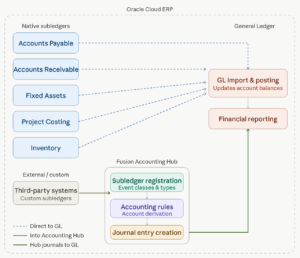
Key Capabilities of Oracle Accounting Hub
- Multi-Source Integration:
Oracle FAH enables seamless integration with various systems, from ERPs to industry-specific platforms. This helps centralize accounting data without overhauling the existing infrastructure. - Customizable Accounting Rules:
The system allows for the creation of custom accounting rules, tailored to specific business needs. It ensures compliance with global accounting standards like IFRS and GAAP while supporting diverse regulatory requirements. - Real-Time Reporting:
With real-time analytics and comprehensive reporting capabilities, FAH provides insights into financial performance across all integrated systems. This enables quicker decision-making. - Compliance and Auditability:
FAH provides a clear audit trail for every accounting entry, which simplifies compliance and auditing processes. It ensures financial transparency across the organization. - Scalability:
Oracle FAH is built to handle massive transactional volumes from multiple source systems simultaneously, applying accounting rules to compress thousands of raw transactions into consolidated, summarized journal entries that post cleanly to the General Ledger. Rather than bloating the chart of accounts with granular operational details, the Hub ingests those data elements as supporting references, using them purely to drive account derivation logic while keeping the GL structure lean and standardized.
Best Practices for Implementing Oracle Accounting Hub
- Comprehensive Requirements Analysis:
Conduct a detailed analysis of your existing financial systems and processes. Identify which source systems require integration and the specific accounting rules for each. This will ensure that FAH is configured correctly from the start. - Alignment of Accounting Policies:
Ensure that your organization’s accounting policies align with the configuration of FAH. Collaborate with finance and compliance teams to develop rules that adhere to regulatory standards, minimizing the need for future changes. - Utilize Pre-Built Integrations:
Leverage Oracle’s pre-built integration tools and connectors to reduce manual data entry and improve accuracy. Testing these integrations is crucial to ensure that data flows smoothly from all source systems into Oracle FAH. - Establish Strong Data Governance:
Centralizing accounting data requires strong data governance to ensure accuracy and consistency. Appoint data stewards to monitor and maintain data quality across all systems. - Change Management and Training:
Managing the transition to Oracle FAH requires clear communication and training for relevant stakeholders. Offer ongoing support and education to ensure user adoption and a smooth transition. - Phased Implementation:
Consider implementing Oracle FAH in phases. Start with high-priority systems and gradually integrate others, ensuring that any issues are addressed early and minimizing disruption to daily operations. - Continuous Improvement:
Even after implementation, regularly review the system’s performance and adjust accounting rules or integration points as needed. This will ensure the system remains aligned with business goals and regulatory changes.
Conclusion
Oracle Accounting Hub streamlines accounting processes across multiple systems, providing a unified solution for complex financial environments. Implementing FAH is not just about centralizing data; it’s about building a more agile, scalable financial system. Following these best practices will help ensure a smooth implementation and long-term success.
